
EMA Nevşehir
Fairy chimneys, rock-cut churches and underground cities in the heart of Cappadocia. Our newest Erasmus+ course center, for teachers and school staff travelling from abroad.
Courses at this center are open to participants travelling from a country other than Türkiye — a core requirement of Erasmus+ mobility.
Let's take a small tour of Nevşehir and Cappadocia.
Nevşehir is the provincial capital at the heart of Cappadocia, on the volcanic plateau of central Anatolia. Around it lie the landscapes that made the region famous: fairy chimneys, valleys shaped by wind and water, and the rock-cut churches of Göreme, part of a UNESCO World Heritage site since 1985.
In their free time during an Erasmus+ training course in Nevşehir, participants can see the painted churches of the Göreme Open-Air Museum, walk down into the underground cities of Kaymaklı and Derinkuyu, climb Uçhisar Castle or watch potters at work in Avanos — a region where geology, history and everyday life sit side by side.
Nevşehir is the provincial capital at the heart of Cappadocia, on the central Anatolian plateau at about 1,200 metres. Around it lies one of Türkiye's most unusual landscapes: valleys of soft volcanic stone worn into cones, pillars and ridges, with churches, dovecotes, houses and whole underground towns cut into the rock. Since 1985 the core of it has been protected as the UNESCO World Heritage Site “Göreme National Park and the Rock Sites of Cappadocia”. Outside training hours, the open-air museums and valleys are a short ride away.
Skip to the practical information ↓
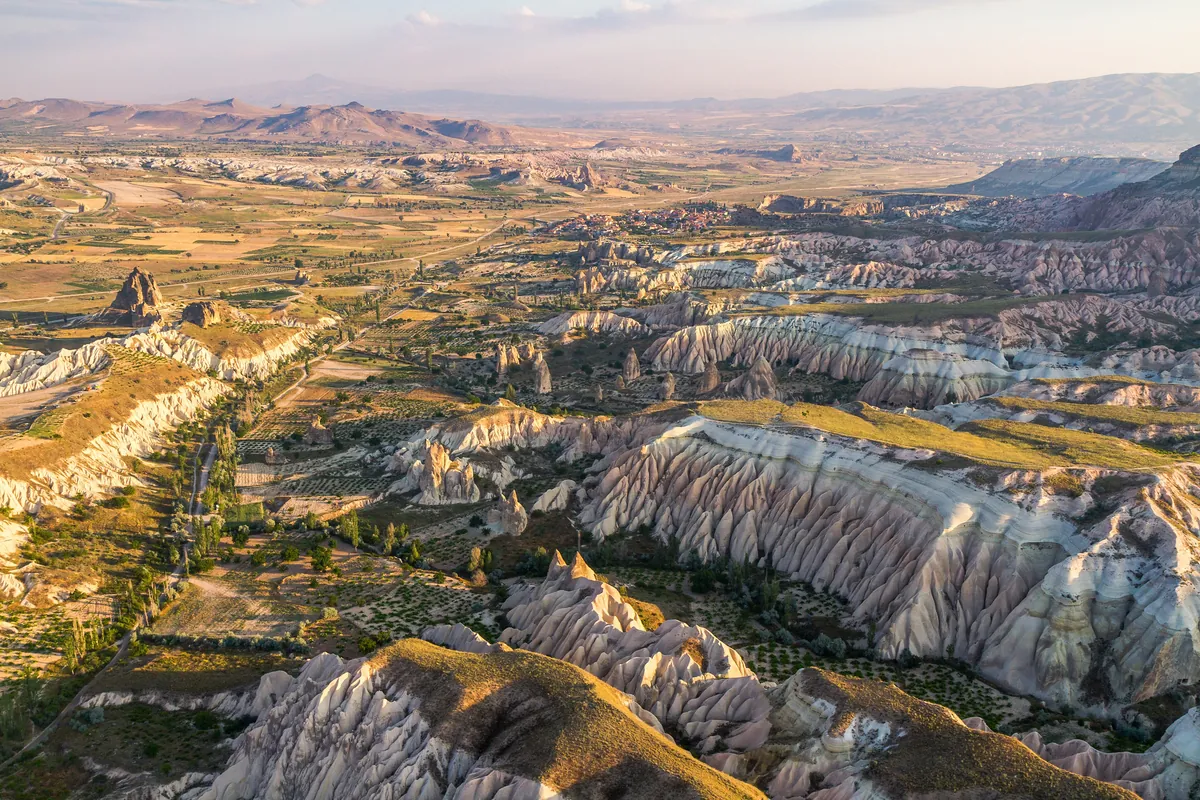
The Cappadocia landscape from the air. The valleys, villages and open-air museums on this page are spread around Nevşehir town; more on each below.
Stone, wind and a long human story
The rock here is tuff: volcanic ash laid down by eruptions roughly 10 to 3 million years ago, then slowly carved by water and wind. Where a harder cap stone sits on top, it shelters the softer layers below, which is how the region's “fairy chimneys” form. The region's great volcanoes, Erciyes and Hasan, still frame the horizon on clear days.
Because tuff is easy to carve, people cut their homes, storerooms and places of worship straight into it. Monastic life took root here from the 4th century, following the rules for shared monastic life written by Basil of Caesarea (today's Kayseri). Over the centuries that followed, monks and hermits carved hundreds of churches and chapels; most of the painted ones that survive date from the 9th to the 13th century. You can still see their frescoes in the open-air museums today.
Nevşehir is EMA's newest course center. Courses at this center are open to participants travelling from a country other than Türkiye — a core requirement of Erasmus+ mobility — so you train alongside teachers and school staff from other countries. Why choose Nevşehir:
- A week in Cappadocia, home to the UNESCO World Heritage site of Göreme and the rock sites around it, with geology, Byzantine art and Ottoman history in one region.
- Open-air museums, underground cities and marked valley trails to explore in your free time.
- Two airports serving the region, and a provincial town with hospitals, shops and the region's main bus station.
Göreme Open-Air Museum — painted churches in the rock
A former monastic settlement just outside Göreme village, where you can see many of Cappadocia's rock-cut churches and their frescoes in one visit.
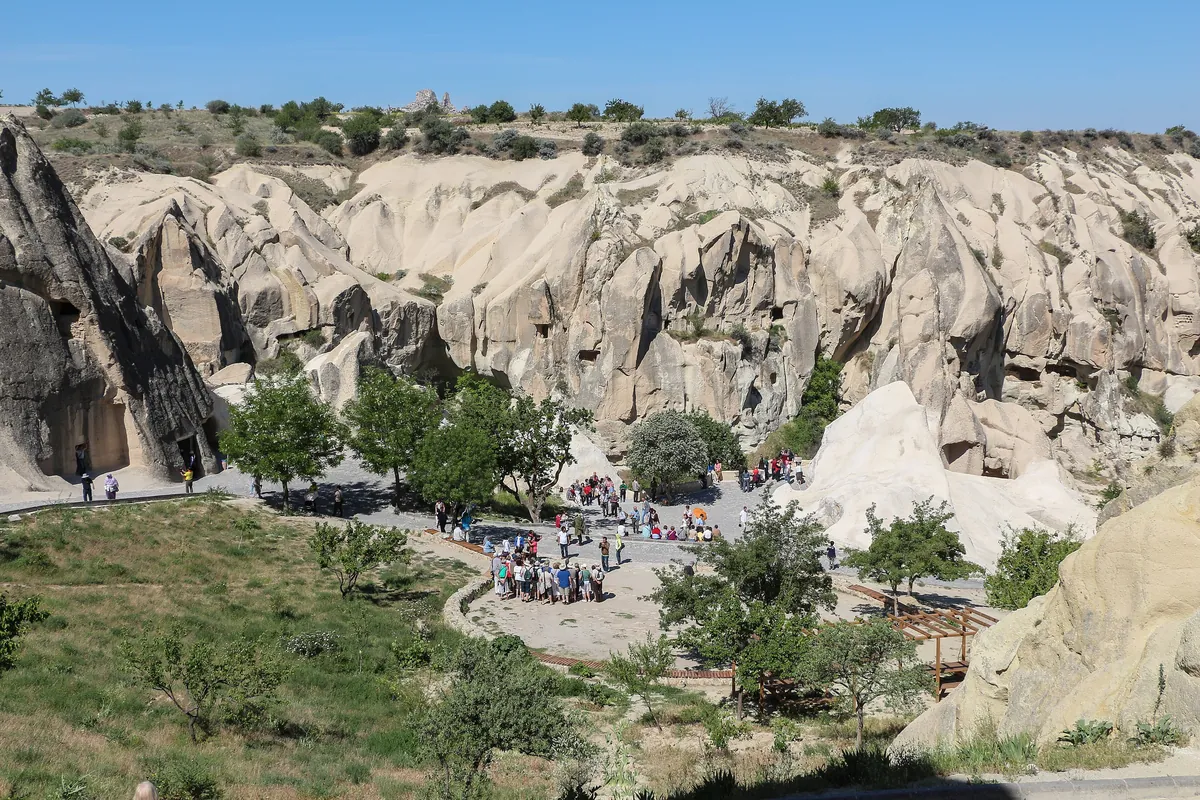
The Göreme Open-Air Museum valley, with its rock-cut chambers.
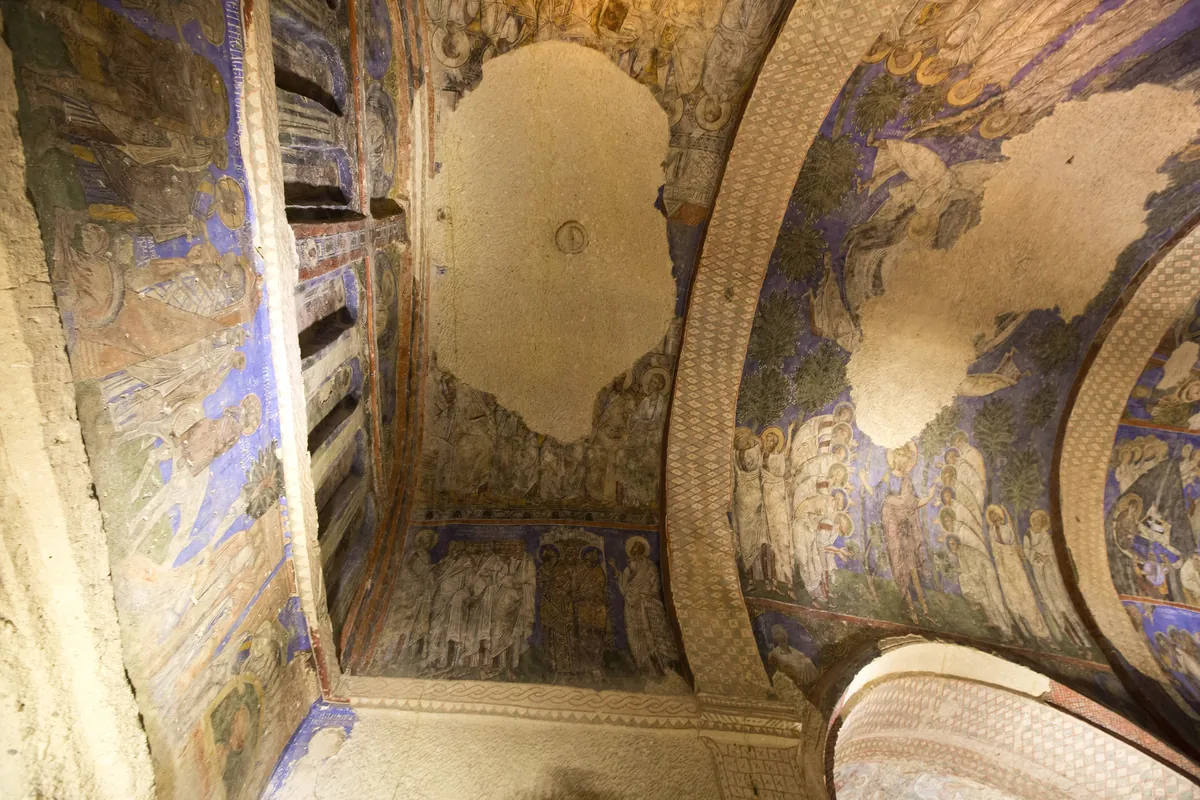
Frescoes in the Tokalı Church, painted in the 10th century.
Most of the decoration you see dates from after Iconoclasm (726–787 and 814–842), the two periods when religious images were banned across the Byzantine Empire. The Tokalı Church and the El Nazar Church nearby are 10th-century; the Elmalı and Karanlık (“Dark”) churches inside the museum are usually dated to the 11th century, though some scholars argue for a date as late as the early 13th century.
The same softness that made the rock easy to carve also makes it fragile: erosion is an ongoing threat to several of the churches, which is why some interiors are closed or restored in turn. It is also the busiest site in the region, so expect queues at peak times.
Kaymaklı and Derinkuyu — the underground cities
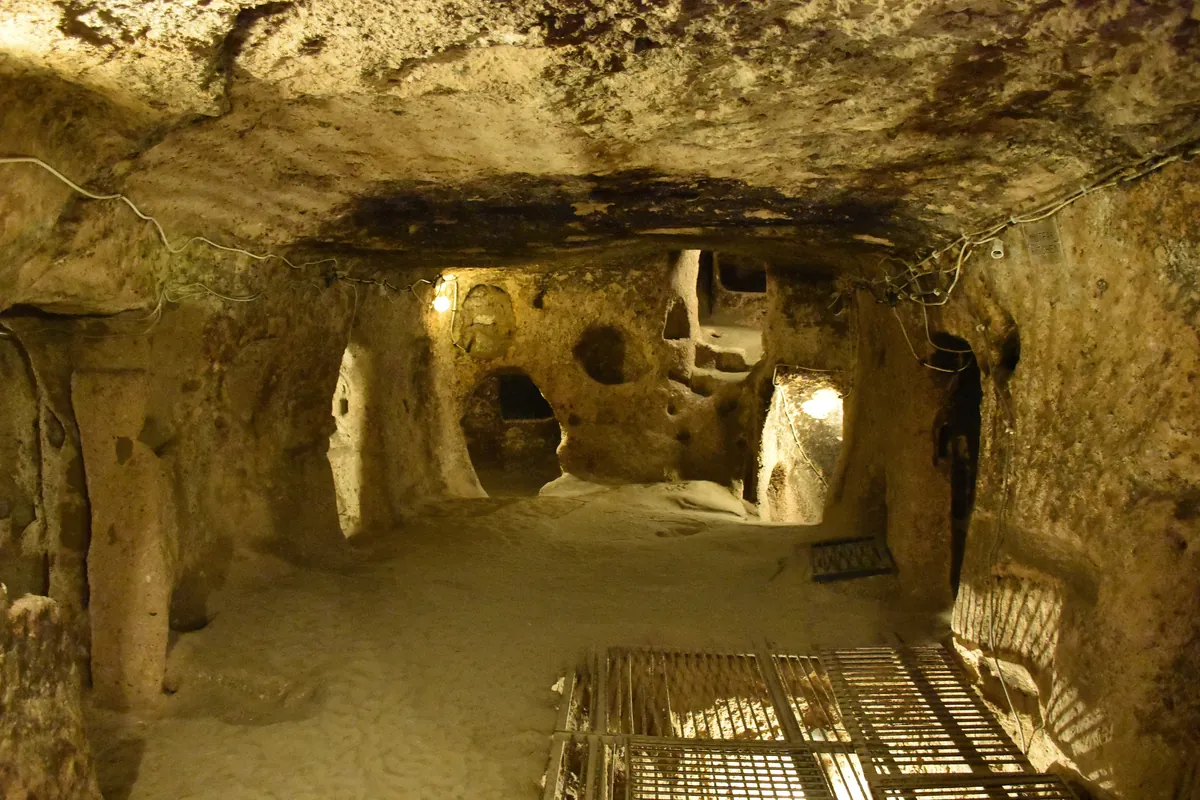
South of Nevşehir, whole settlements were dug downwards rather than up: networks of rooms, stables, wine presses, chapels and narrow passages, with rolling stone doors that could seal a level from the inside. They served as refuges in times of danger; exactly when digging began is still debated.
Derinkuyu reaches about 85 metres down (estimates vary); several levels are open to visitors, and its deep ventilation shaft also served as a well. Kaymaklı has four floors open. You will often read how many thousands of people these cities could shelter; those figures are estimates, not records. Passages are low and narrow in places, so expect to bend down; if you dislike small spaces, stay on the upper levels.
Uçhisar, Paşabağı and Avanos
Three short stops between Nevşehir and the Kızılırmak river, easy to combine on a free afternoon.
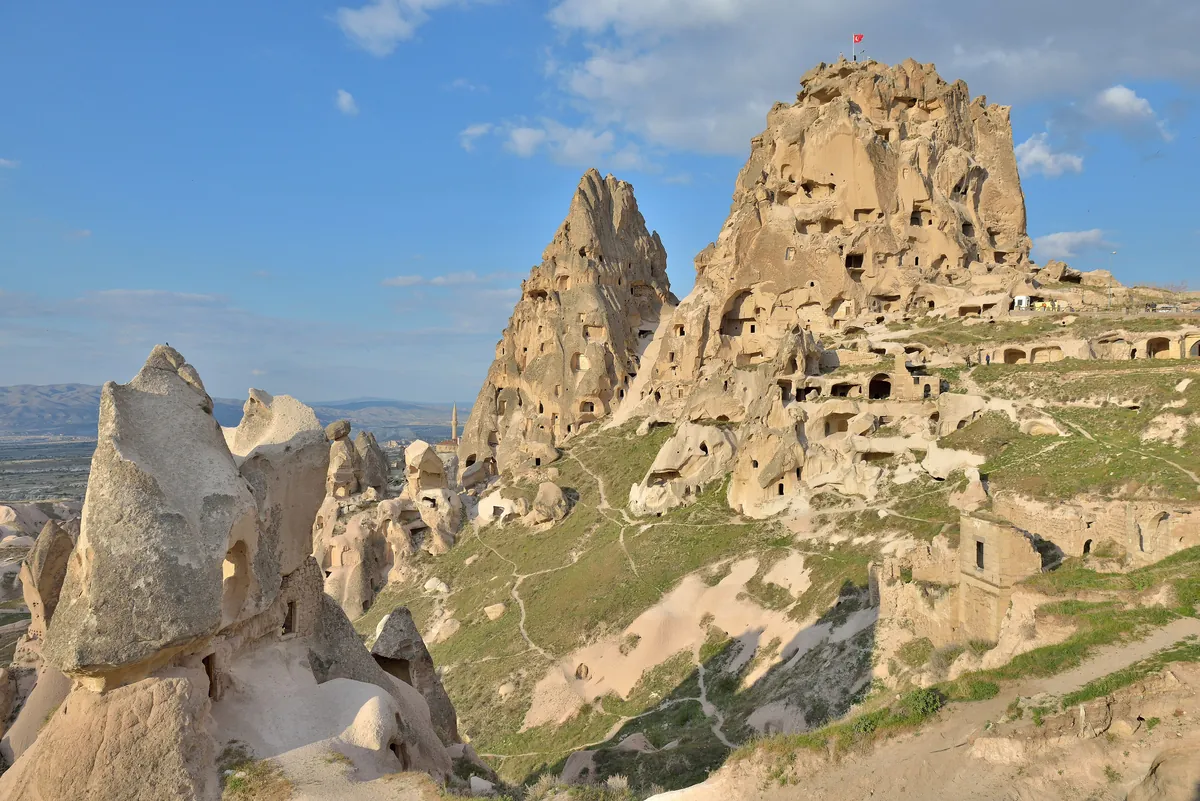
Uçhisar Castle — a tall rock full of carved rooms, above the village. The top is a viewpoint over the valleys towards Göreme.
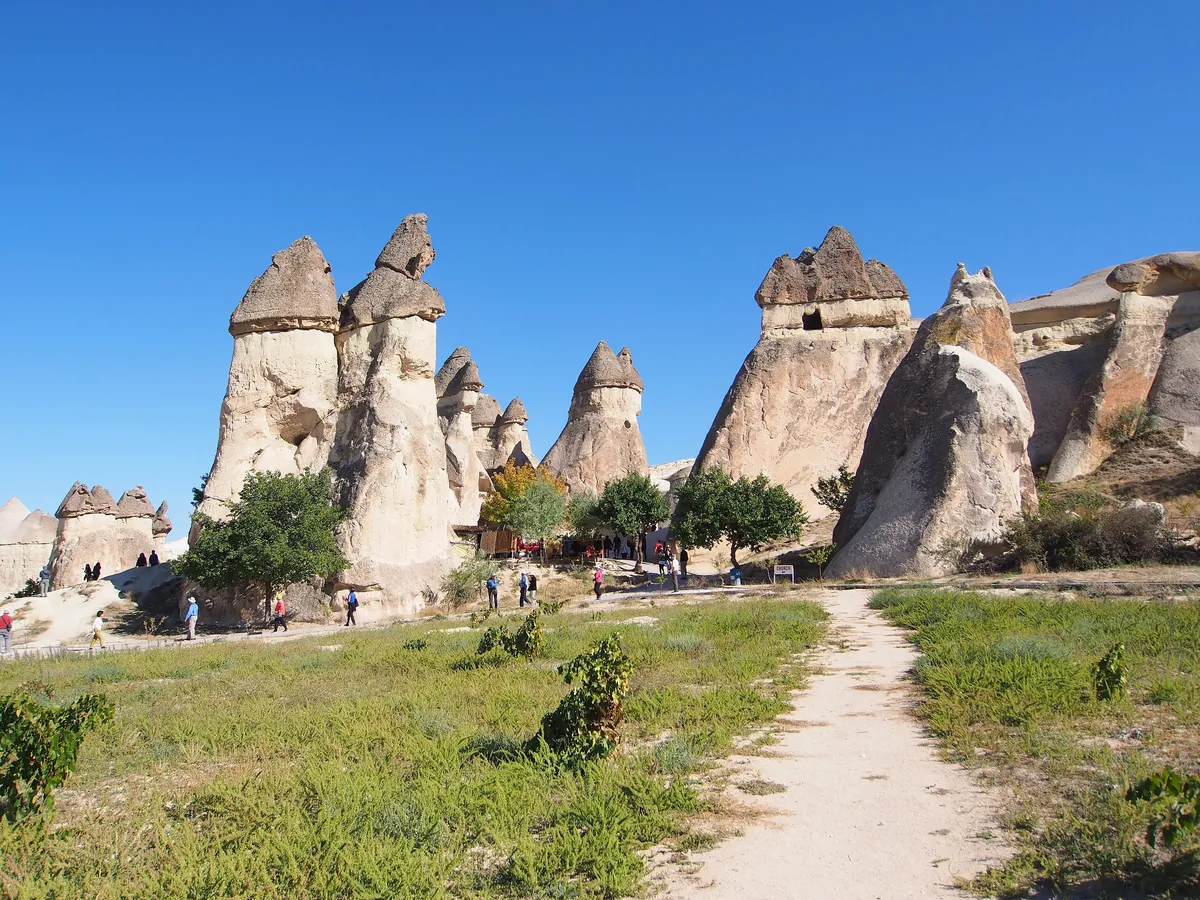
Paşabağı — the valley of multi-capped fairy chimneys. Legend says a hermit named Simeon lived in a chapel carved into one of them; that is local tradition, not documented history.
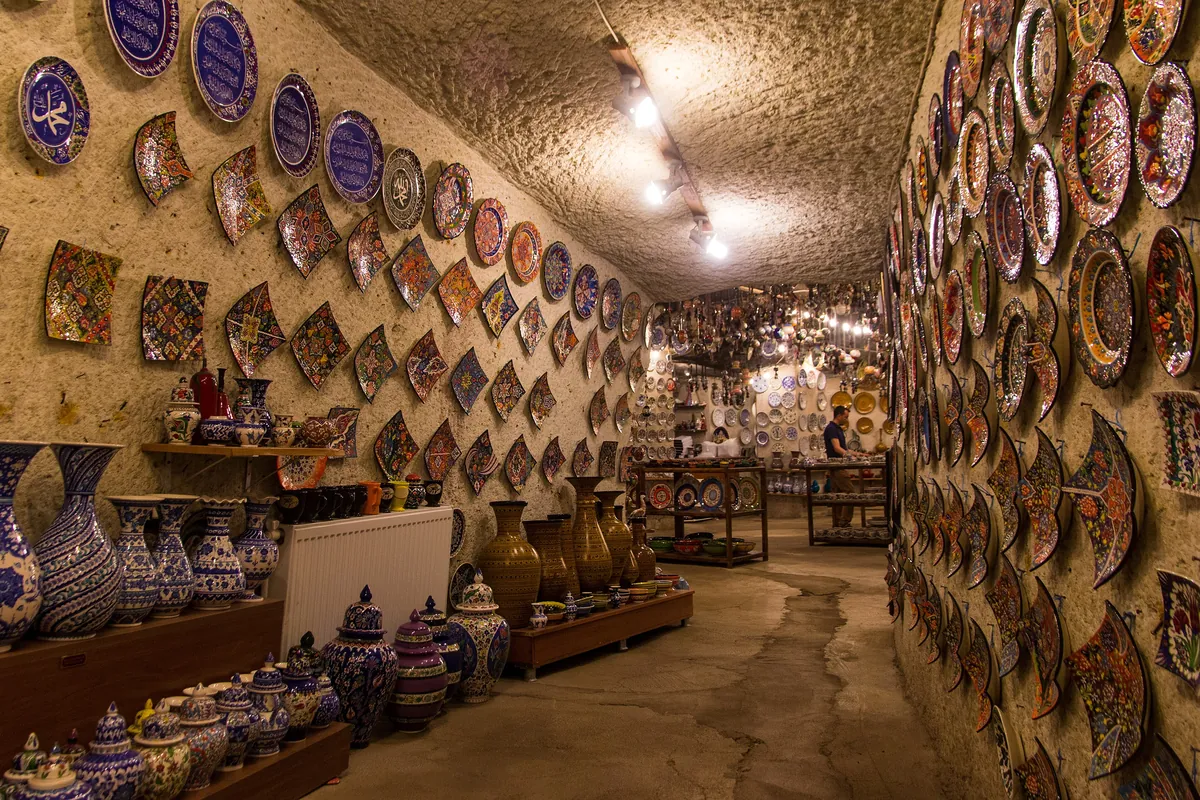
Avanos — a riverside town on the Kızılırmak, Türkiye's longest river, known for pottery made from the river's red clay. Many workshops welcome visitors to watch a wheel demonstration.
Valley walks and morning balloons
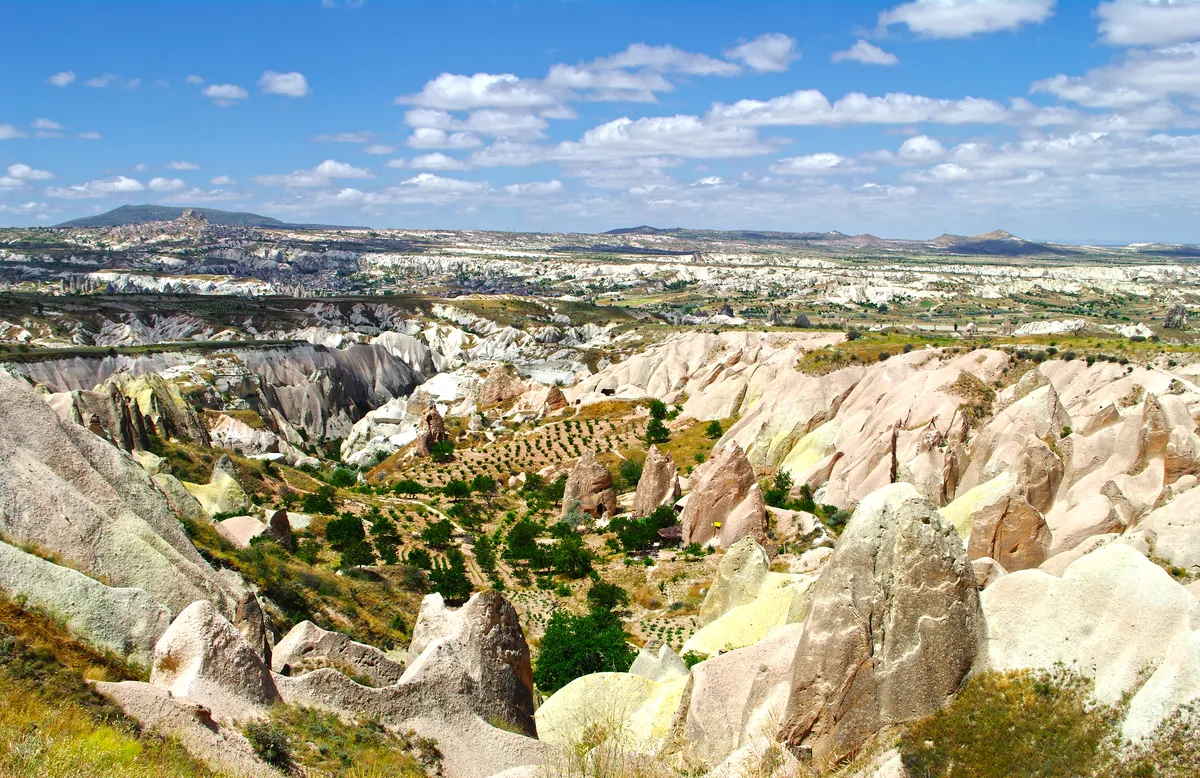
The valleys between Göreme and Çavuşin, among them the Rose and Red valleys (Güllüdere and Kızılçukur), are crossed by walking trails past pink-tinted ridges, orchards and small rock-cut churches. They are popular in the late afternoon, when the stone changes colour; see the safety tips below before you set out.
On many mornings, hot-air balloons rise over the valleys around Göreme. They fly only with official permits and only in suitable weather, so flights are often cancelled on windy days. Watching them from a viewpoint costs nothing. If you want to fly, book privately; flights are not included in the course fee.
Two places beyond the central valleys are worth knowing about if you have an extra day. Neither is a quick trip, so check the route on a map before you plan around them:
Ihlara Valley — a deep river canyon lined with rock-cut churches, in neighbouring Aksaray province. A full day out rather than an afternoon.
Soğanlı — a quieter valley of painted rock churches to the south, in Kayseri province, far less visited than Göreme.
Photos via Wikimedia Commons, resized and converted to WebP by EMA; our edited copies carry the same licences: Cappadocia aerial view — Benh LIEU SONG, CC BY-SA 4.0 · Kurşunlu Mosque, Nevşehir — Dosseman, CC BY-SA 4.0 · Göreme Open-Air Museum — Bernard Gagnon, CC BY-SA 3.0 · Tokalı Church — prilfish, CC BY 2.0 · Kaymaklı Underground City — MusikAnimal, CC BY-SA 4.0 · Uçhisar Castle — Wolfgang Moroder, CC BY-SA 3.0 · Paşabağı — rheins, CC BY 3.0 · Avanos pottery workshop — Alexey Komarov, CC BY-SA 4.0 · Rose Valley — Zeynel Cebeci, CC BY-SA 4.0.
Photo at the top of the page: Hot air balloons at dawn, Uçhisar — Wolfgang Moroder, CC BY-SA 3.0, resized by EMA.
Quick facts about Nevşehir
Before you arrive
Arrange these two things well before departure. Neither takes long, but neither should be left until the airport.
Visa & entry requirements
Most EU passport holders can enter Türkiye visa-free for short stays (generally up to 90 days in any 180), but the rules depend on your nationality, so check yours on the Turkish Ministry of Foreign Affairs site. Some nationalities need an e-Visa, and Greek Cypriot passport holders need a visa from a Turkish mission or evisa.gov.tr. The e-Visa covers tourism and business trips; if you are unsure how a training visit counts for your passport, ask the nearest Turkish consulate. Türkiye requires your passport to be valid for at least 60 days beyond the end of your visa or visa-free period; for the usual 90-day visa-free stay, that means at least 150 days from the day you arrive.
Visa rules by nationality ↗Travel insurance
We recommend a policy covering medical expenses, trip cancellation and lost baggage for the duration of your stay. The European Health Insurance Card (EHIC) is not valid in Türkiye, so private cover matters here.
Weather & packing
Cappadocia sits high on the Anatolian plateau, so it is drier and has bigger day-to-night swings than the Turkish coast. Averages below (day high / night low) are from the Turkish State Meteorological Service's Nevşehir station.
| Season | Day high / night low | What to expect |
|---|---|---|
| Spring (Mar–May) | March ~10°C / 1°C · April ~16°C / 5°C · May ~21°C / 9°C | Mild days and chilly nights, close to freezing in March; May is one of the wetter months, with showers rather than long rain. |
| Summer (Jun–Aug) | June ~25°C / 12°C · July–August ~29°C / 14°C | Dry and sunny, with cool evenings at this altitude. Sun protection matters on valley walks. |
| Autumn (Sep–Nov) | September ~25°C / 11°C · October ~18°C / 7°C · November ~12°C / 3°C | Settled, dry weather in September, cooling quickly through October; November nights can be close to freezing. |
| Winter (Dec–Feb) | December–February ~4–6°C / −4 to −1°C | Frost is common and snow is possible. Bring a proper winter coat, warm layers and shoes with grip. |
Documents
Clothing
Electronics
Health & money
Getting here
Two airports serve Cappadocia: Kapadokya Airport (NAV), about 30 km from Nevşehir town, and Kayseri Airport (ASR), about 90 km away. Most international travellers reach either one with a connecting flight via İstanbul.
| From | Options | Distance to Nevşehir |
|---|---|---|
| Kapadokya Airport (NAV) | Shuttles timed to flights serve the main Cappadocia towns (check the current operator and route at the airport); the airport taxi rank; car-rental desks in the terminal | ~30 km |
| Kayseri Airport (ASR) | Airport buses run to Kayseri bus station or into the city, where you change to a bus for Nevşehir (check the current service before you travel); taxis and car rental also available | ~90 km; about 1 h 40 min by road, longer by bus with the change |
Getting around locally:
The course venue
We confirm the exact venue with your booking. It will be in the Cappadocia area of Nevşehir province, not necessarily in Nevşehir town itself, and we send it with the easiest way to reach it from where you stay.
Minibuses (dolmuş)
Minibuses link Nevşehir's bus station with Uçhisar, Göreme, Avanos and Ürgüp. Timetables change with the season, so check current times locally.
Taxis
Licensed, metered taxis work in Nevşehir and the main villages, and are the simplest option with luggage or after dark.
Where to stay
Cappadocia is a cluster of small towns rather than one city. You can book flights straight away, since both airports serve the whole area; for accommodation, wait until we confirm the venue so you can stay close to it. The main bases:
| Area | Why stay here |
|---|---|
| Nevşehir town | The provincial capital: business hotels, everyday shops and the main bus station. Practical rather than scenic. |
| Göreme | The tourist village next to the Open-Air Museum, full of cave hotels and restaurants, and the hub of the balloon flights. Busy in high season. |
| Uçhisar | A smaller, quieter village below its castle, with views over the valleys. |
| Ürgüp | A larger market town with a good choice of hotels and restaurants, and local wineries nearby. |
Prices vary a great deal with season, and cave hotels in Göreme fill up from spring to autumn, so book soon after we confirm the venue; a room with free cancellation keeps your options open. Compare current listings for Cappadocia ↗
Money
Cards & cash
Cards are widely accepted in hotels, restaurants and larger shops; keep some TRY for minibuses, small cafés and market stalls. Withdrawing lira from a bank ATM usually gives a better rate than airport exchange counters.
Museum tickets
Fees for foreign visitors at state museums and sites are set in euros. In 2026: Göreme Open-Air Museum €20, Kaymaklı and Derinkuyu €13 each, Zelve–Paşabağı €12. Tickets are not included in the course fee, and prices change, so check before you go.
Before you fly
Notify your bank you're travelling, so a card payment in Türkiye doesn't get blocked as suspicious. Carry a backup card if you have one.
Tipping
Around 10% in restaurants is customary, often left in cash. Rounding up for taxis is common and appreciated.
Safety & practical info
Nevşehir and Cappadocia are outside the only area the UK Foreign Office advises against visiting (within 10 km of the Syrian border, as of November 2026). Check your own government's travel advice as well; normal travel precautions cover most situations.
| Topic | Advice |
|---|---|
| Valley walks | Stay on marked paths, wear proper shoes, take water, and don't start out late; the tuff is crumbly near edges and trails are not lit. |
| Balloon flights | Book only with a licensed operator, and accept a weather cancellation rather than looking for someone who will fly anyway. |
| Valuables | Keep bags close at busy sites and viewpoints, as you would anywhere popular with visitors. |
Culture & etiquette
Cappadocia welcomes visitors from all over the world, while the towns around it remain fairly traditional. A few courtesies go a long way:
| Topic | Guidance |
|---|---|
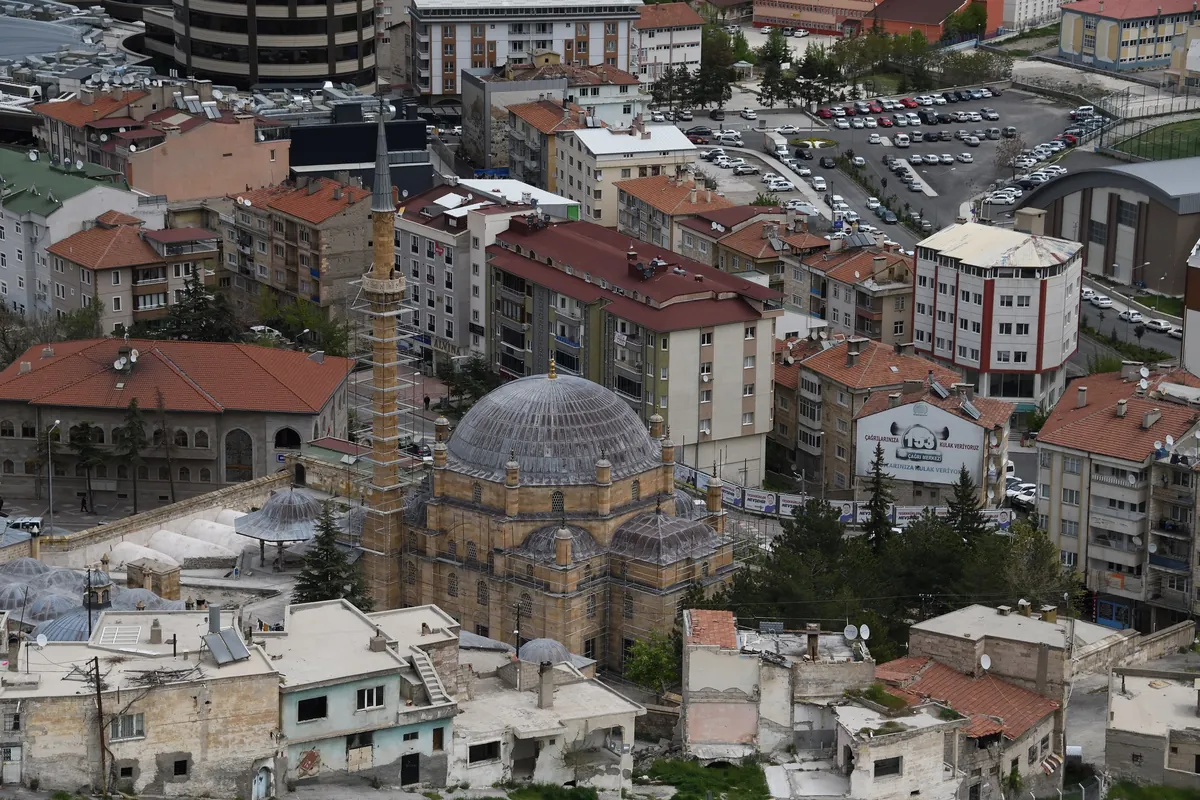
| Mosques | Remove your shoes before entering and dress modestly, for example at the Kurşunlu Mosque in Nevşehir town. |
| Painted churches | Follow the signs on photography inside the churches; the frescoes are fragile. |
| Greetings | "Merhaba" (hello) is always welcome, as are "lütfen" (please) and "teşekkür ederim" (thank you). |
| Dress code | Casual dress is fine day to day; dress more modestly in mosques and in Nevşehir town and smaller villages. |
| Ramadan | Dates follow the lunar calendar (in 2027 it begins around 8 February). Restaurants stay open, but eating discreetly in public during the day is a courtesy. |
| Photography | Always ask before photographing people directly. |
Cappadocian food & dining
A few things that are specific to this region, not just "Turkish food in general":
| Dish | What it is |
|---|---|
| Testi kebabı | Meat and vegetables slow-cooked in a sealed clay pot, often made in Avanos, which is cracked open at the table. Cappadocia's best-known dish. |
| Local wine | Vines have long been grown in the volcanic soil; look for wines from the local white grape, Emir. Several wineries around Ürgüp and Uçhisar have tasting rooms. |
Beyond these, the wider Turkish classics (pide, lahmacun, meze, baklava) are easy to find in every town.
We arrange tailor-made Erasmus+ sessions on demand — tell us your preferred topic and travel window and we'll schedule it.